Vanguard Foreign Tax Credit 2025: Every Eligible ETF's Data
If you hold a Vanguard international ETF in a taxable account, part of your dividend income was paid to foreign governments before it reached you. You can usually claim a foreign tax credit for it, which reduces your U.S. tax. To do it, you need three numbers from Vanguard's annual foreign tax credit supplement.
We pulled the 2025 figures for all 13 Vanguard ETFs on the list, explained what each column means, and estimated how much foreign tax each fund pays per $10,000 invested. We also worked out how large a position you can hold before you have to file Form 1116.
Which tax year: these are the figures for 2025 returns. They're useful for amending a 2025 return and for planning for 2026. Vanguard publishes the 2026 figures in early 2027, and we'll update this page then.
The 2025 Numbers for Every Vanguard ETF
These figures come from Vanguard's supplement 2025 Foreign Tax Credit Information for Eligible Vanguard Funds.
| ETF | Fund | Foreign source income (% of Box 1a) | Qualified foreign dividends (% of Box 1a) | Foreign tax paid (%) |
|---|---|---|---|---|
| VXUS | Total International Stock | 81.9551% | 58.4599% | 7.11% |
| VEU | FTSE All-World ex-US | 80.6801% | 59.3306% | 8.26% |
| VEA | FTSE Developed Markets | 79.6488% | 66.2741% | 6.46% |
| VWO | FTSE Emerging Markets | 87.1741% | 34.6250% | 10.93% |
| VYMI | International High Dividend Yield | 99.3532% | 73.2632% | 8.49% |
| VIGI | International Dividend Appreciation | 99.9771% | 93.9707% | 10.71% |
| VSS | FTSE All-World ex-US Small-Cap | 77.2464% | 46.8695% | 10.00% |
| VGK | FTSE Europe | 94.2430% | 85.0916% | 7.73% |
| VPL | FTSE Pacific | 62.0312% | 47.9767% | 4.40% |
| VSGX | ESG International Stock | 75.3192% | 53.2493% | 7.82% |
| VEXC | Emerging Markets Select Ex-China | 100.0000% | 37.0853% | 5.13% |
| VNQI | Global ex-U.S. Real Estate | 77.8215% | 12.9651% | 7.23% |
| BNDX | Total International Bond | 58.4106% | 0.0000% | 0.17% |
The same percentages apply to each fund's mutual fund share class where one exists (for example, VTIAX for Total International Stock). VEXC and VSGX are ETF-only.
What Each Column Means
Foreign source income (% of Box 1a). This is the share of your total ordinary dividends (Box 1a of Form 1099-DIV) that came from foreign sources. If you file Form 1116, it's the figure you need for foreign-source income. It isn't 100% for most funds because part of the dividend income is treated as U.S.-source.
Qualified foreign dividends (% of Box 1a). This is the share of Box 1a that was both foreign and qualified, meaning eligible for the lower 0%, 15% or 20% rates. Form 1116 has an adjustment for qualified dividends because they're taxed at lower rates, and this column feeds that adjustment.
Foreign tax paid (%). These are the foreign taxes withheld, as a percentage of the cash dividends the fund actually paid out (already net of withholding). Your Form 1099-DIV shows the actual dollar amount in Box 7. Vanguard says to use this percentage only if you didn't receive a 1099-DIV, by multiplying it by the ordinary cash dividends you were paid.
Some patterns stand out:
- VWO, VIGI and VSS have the highest foreign tax rates: foreign tax equal to 10.93%, 10.71% and 10.00% of the cash dividends paid. VPL (4.40%) has the lowest of the stock funds.
- VIGI and VGK are the most "qualified." About 94% and 85% of their income is qualified foreign dividends, compared with 35% for VWO and 13% for VNQI. Real estate trusts often don't qualify, and neither do many companies based in countries without a comprehensive U.S. tax treaty, such as Taiwan and Brazil.
- BNDX barely matters. Bond interest is rarely taxed at the source, so its foreign tax is 0.17%.
How Much Foreign Tax That Is per $10,000
The percentages above are a share of each fund's dividends, not of your investment. To compare funds, we multiplied each fund's foreign tax rate by its trailing 12-month yield as of November 21, 2026.
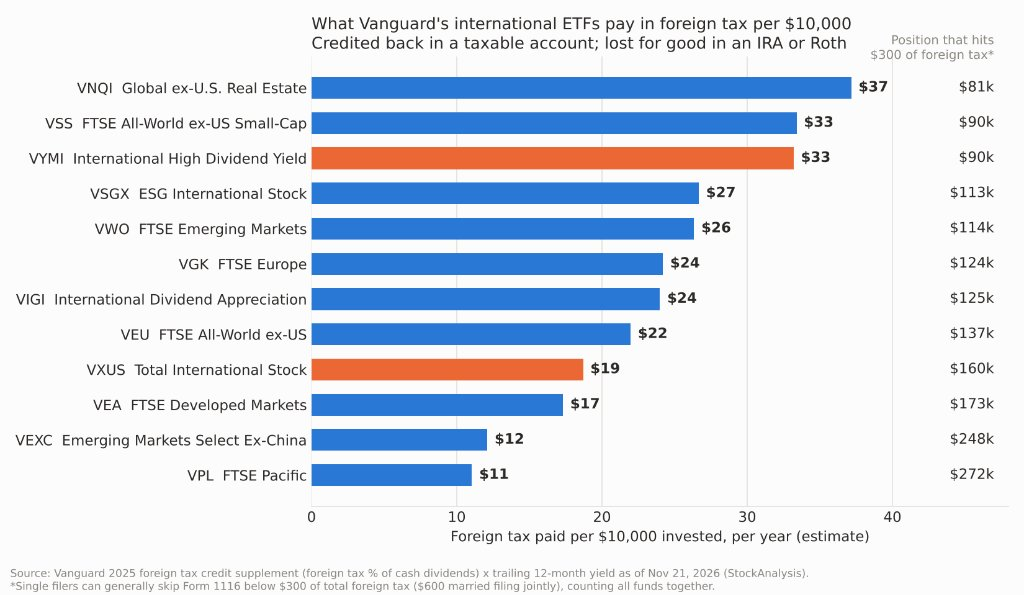
| ETF | Yield (TTM) | Dividends per $10,000 | Foreign tax per $10,000 | Position where foreign tax hits $300 | …hits $600 |
|---|---|---|---|---|---|
| VNQI | 5.14% | $514 | $37 | $81,000 | $161,000 |
| VSS | 3.34% | $334 | $33 | $90,000 | $180,000 |
| VYMI | 3.91% | $391 | $33 | $90,000 | $181,000 |
| VSGX | 3.41% | $341 | $27 | $113,000 | $225,000 |
| VWO | 2.41% | $241 | $26 | $114,000 | $228,000 |
| VGK | 3.13% | $313 | $24 | $124,000 | $248,000 |
| VIGI | 2.24% | $224 | $24 | $125,000 | $250,000 |
| VEU | 2.66% | $266 | $22 | $137,000 | $273,000 |
| VXUS | 2.63% | $263 | $19 | $160,000 | $321,000 |
| VEA | 2.68% | $268 | $17 | $173,000 | $347,000 |
| VEXC | 2.36% | $236 | $12 | $248,000 | $496,000 |
| VPL | 2.51% | $251 | $11 | $272,000 | $543,000 |
| BNDX | 4.66% | $466 | $0.79 | $3.8 million | $7.6 million |
These are estimates. They apply the 2025 foreign tax rates to yields measured in late 2026, and both change every year. Your actual foreign tax paid is the Box 7 amount on your 1099-DIV. The credit can be smaller if the Form 1116 limit applies or the holding period isn't met.
Do You Need Form 1116?
Many investors can skip Form 1116 and claim the credit directly on Schedule 3 of Form 1040. You can generally make this election if all of these are true:
- Your total creditable foreign taxes are $300 or less ($600 or less if married filing jointly).
- All of your foreign income is passive income, such as dividends and interest.
- All of the income and foreign tax are reported to you on a payee statement, such as a Form 1099-DIV.
The $300/$600 limit is for all your foreign taxes combined, across every fund and every brokerage account. Based on the table above, a single filer whose only international fund is VXUS could hold roughly $160,000 before needing Form 1116. With VYMI, the limit is roughly $90,000.
Trade-offs of skipping Form 1116:
- The usual credit limitation doesn't apply, so you get the full credit as long as you owe at least that much U.S. tax.
- You can't carry any unused credit to another year.
If you're over the limit, file Form 1116. The 1099-DIV and Vanguard's supplement give you most of what you need:
- Foreign tax paid: Box 7 of your 1099-DIV.
- Foreign-source gross income: Box 1a × the fund's "foreign source income" percentage.
- Qualified foreign dividends: Box 1a × the fund's "qualified foreign dividends" percentage, used for the qualified dividend adjustment in the Form 1116 instructions.
Most tax software asks for these numbers fund by fund and does the adjustment for you.
Holding period: you can claim the foreign tax only if you held the shares for at least 16 days during the 31-day period that begins 15 days before the ex-dividend date. Shares bought and sold around a dividend date don't qualify, and days when your risk of loss is hedged don't count. The qualified-foreign percentage also assumes you met the separate holding period for qualified dividends (more than 60 days in a 121-day window).
Worked Example: $200,000 in VXUS
A single filer holds $200,000 of VXUS in a taxable account.
| Step | Calculation | Amount |
|---|---|---|
| Cash dividends | $200,000 × 2.63% | about $5,260 |
| Foreign tax (Box 7) | $5,260 × 7.11% | about $374 |
| Over the $300 limit? | $374 > $300 | Yes, file Form 1116 |
| Foreign-source income | Box 1a × 81.9551% | (from your 1099) |
| Qualified foreign dividends | Box 1a × 58.4599% | (from your 1099) |
At $150,000 instead, the foreign tax would be about $280. The filer could then skip Form 1116, as long as they had no other foreign taxes.
Funds That Aren't on the List
U.S. stock funds (VOO, VTI, VYM, SCHD and so on) pay little foreign tax and can't pass it through, so there's nothing to claim.
Vanguard Total World Stock ETF (VT) isn't on the list either, even though it holds thousands of international stocks. A fund can pass foreign taxes through to shareholders only if more than 50% of the value of its total assets is in stock or securities of foreign corporations at the end of its fiscal year, and it elects to do so (IRC §853). VT is mostly U.S. stocks, so it doesn't qualify. VT's foreign taxes still reduce its distributions, but shareholders can't claim a credit for them. For a taxable account, holding VTI plus VXUS separately keeps the credit. VT alone doesn't.
Target Retirement and LifeStrategy funds are on the list, even though they're less than half foreign. As qualified funds of funds, they can pass through the foreign tax paid by the international funds they hold. A qualified fund of funds keeps at least 50% of its assets in other funds at the end of each quarter (IRC §852(g)). Their rates are small: for example, 3.88% for Target Retirement 2050 and 3.27% for LifeStrategy Growth. These funds are usually held in retirement accounts, where the credit doesn't apply.
The Credit Only Works in a Taxable Account
In an IRA, Roth IRA or 401(k), you pay no U.S. tax on dividends, so there's nothing for the foreign tax to offset. The amounts in the per-$10,000 table are simply lost each year. That's why international funds are often better held in a taxable account than in a Roth.
We ran the full asset location comparison in our foreign tax credit analysis of VXUS, VYMI, VEA and VWO. We cover VYMI's after-tax yield by bracket in our VYMI dividend history.
Frequently Asked Questions
Where is the foreign tax on my 1099-DIV?
In Box 7, "Foreign tax paid." Box 8 shows the foreign country or U.S. possession. For funds, it usually says "RIC" or "various."
When does Vanguard publish the foreign tax credit percentages?
Vanguard posts the supplement early in the year, alongside 1099 forms. The 2025 figures above come from the supplement dated January 2026. The 2026 figures are expected in early 2027.
Can I deduct foreign taxes instead of taking the credit?
Yes, if you itemize, you can deduct foreign taxes on Schedule A instead, but you must choose the credit or the deduction for all of your foreign taxes that year. The credit reduces your tax dollar for dollar, while a deduction only reduces your taxable income, so the credit is usually worth more.
Does the foreign tax credit reduce the 3.8% net investment income tax?
No. The credit offsets federal income tax (regular tax and alternative minimum tax), not the 3.8% NIIT.
Is the foreign tax credit worth it for small positions?
Yes, and for most small investors it's simple. With less than about $300 of foreign tax, you can usually claim it on Form 1040 without Form 1116. On $50,000 of VXUS, that's roughly $94 a year.
Methodology and Limitations
- Fund data: Vanguard, 2025 Foreign Tax Credit Information for Eligible Vanguard Funds (supplement FTCWS 012026). Percentages are quoted exactly.
- Yields: trailing 12-month distributions divided by price, from StockAnalysis, as of November 21, 2026.
- Estimates: the per-$10,000 and position-size figures multiply the 2025 foreign tax rates by late-2026 yields. Both change each year, so treat them as approximations. Your 1099-DIV is the authority.
- Tax rules: based on IRS rules for the foreign tax credit (Form 1116 and the de minimis election), the 16-day holding period, and the pass-through rules for regulated investment companies (more than 50% foreign assets, or a qualified fund of funds). State taxes aren't covered.
Data: vanguard-foreign-tax-credit-2025.csv
Sources: Vanguard 2025 foreign tax credit information; Vanguard FTC supplement FTCWS 012026; IRS Instructions for Form 1116; IRS Instructions for Form 1099-DIV; IRS Publication 514.
The Bottom Line
Every Vanguard international stock ETF paid foreign tax in 2025, equal to 4.40% (VPL) to 10.93% (VWO) of the cash dividends it paid. In a taxable account, you can usually claim it as a credit. A single filer whose only international fund is one of these can generally stay under the $300 limit, and skip Form 1116, up to roughly $81,000 (VNQI) to $272,000 (VPL), or about $160,000 for VXUS. Joint filers can hold about twice that. In an IRA or Roth, the money is gone.
Use Box 7 of your 1099-DIV for the dollar amount, and Vanguard's percentages above if you need to file Form 1116.