The 12% Bracket Isn't 12% for Dividend Investors: The Hidden 27% Zone in Roth Conversions
The 12% Bracket Isn't 12% for Dividend Investors: The Hidden 27% Zone in Roth Conversions
The years between retiring and starting Social Security are often called the Roth conversion window. Income is low, so moving money from a traditional IRA to a Roth IRA can be done at low tax rates. The common advice is simple: convert enough each year to "fill up the 12% bracket."
For a retiree whose income is qualified dividends from a taxable account, that advice hides a problem. In our analysis of the 0% dividend tax bracket, we showed how qualified dividends can be taxed at 0%. A Roth conversion is ordinary income, and ordinary income is counted first. Every dollar converted can push a dollar of dividends out of the 0% rate and into the 15% rate.
We calculated the federal tax on every dollar converted, at different dividend levels, using 2026 IRS figures. The result: much of the "12% bracket" costs 25% to 27%, and filling it can cost twice as much as it would without dividends.
The Scenario
- A single retiree, age 60, with no wages, pension, or Social Security yet.
- $40,000 a year of qualified dividends from a taxable brokerage account. That's roughly what a $1.25 million portfolio yielding 3.2% pays.
- A traditional IRA they'd like to convert to a Roth, a little each year.
- Federal income tax only, under 2026 law, taking the standard deduction.
We also ran married couples filing jointly and other dividend levels. All tax figures come from an implementation of the IRS Qualified Dividends and Capital Gain Tax Worksheet, checked against a second, independent calculation method; the two agreed to the cent across thousands of combinations. We used the IRS rate schedules. The IRS tax tables, which filers use for taxable income under $100,000, can differ by a few dollars.
What "fill the 12% bracket" means here. We mean converting until your ordinary taxable income, meaning taxable income not counting qualified dividends, reaches $50,400 (single), the top of the 12% bracket. That's how the bracket applies to ordinary income. For our retiree, it means converting $66,500. If you instead count your dividends toward the $50,400, you'd convert only $26,500, and as you'll see, that happens to stop near the low-cost limit.
If you receive an ACA premium tax credit, read the health insurance section below before using any of these numbers. For this retiree, the credit disappears entirely at a $22,600 conversion, below the $25,550 low-cost limit and all three plans discussed later, and smaller conversions shrink it.
How Qualified Dividends Are Taxed
Qualified dividends get their own rate schedule, but they don't get their own bracket space. The IRS stacks them on top of ordinary income:
- Deductions are subtracted, starting with ordinary income.
- Ordinary income fills the bottom of the brackets and is taxed at the normal rates.
- Qualified dividends sit on top. The part of the dividends that falls below $49,450 of taxable income (single) or $98,900 (married filing jointly) is taxed at 0%. The part above that line is taxed at 15%.
With only $40,000 of dividends, this retiree's taxable income is $23,900, well under $49,450. Federal tax: $0.
Now add a Roth conversion. The converted dollars are ordinary income, so they go in underneath the dividends and lift them up. Once the dividends are lifted past $49,450 of taxable income, each additional converted dollar does two things at once: it's taxed at the ordinary rate, and it pushes one more dollar of dividends from 0% to 15%.
The Rate on Every Converted Dollar
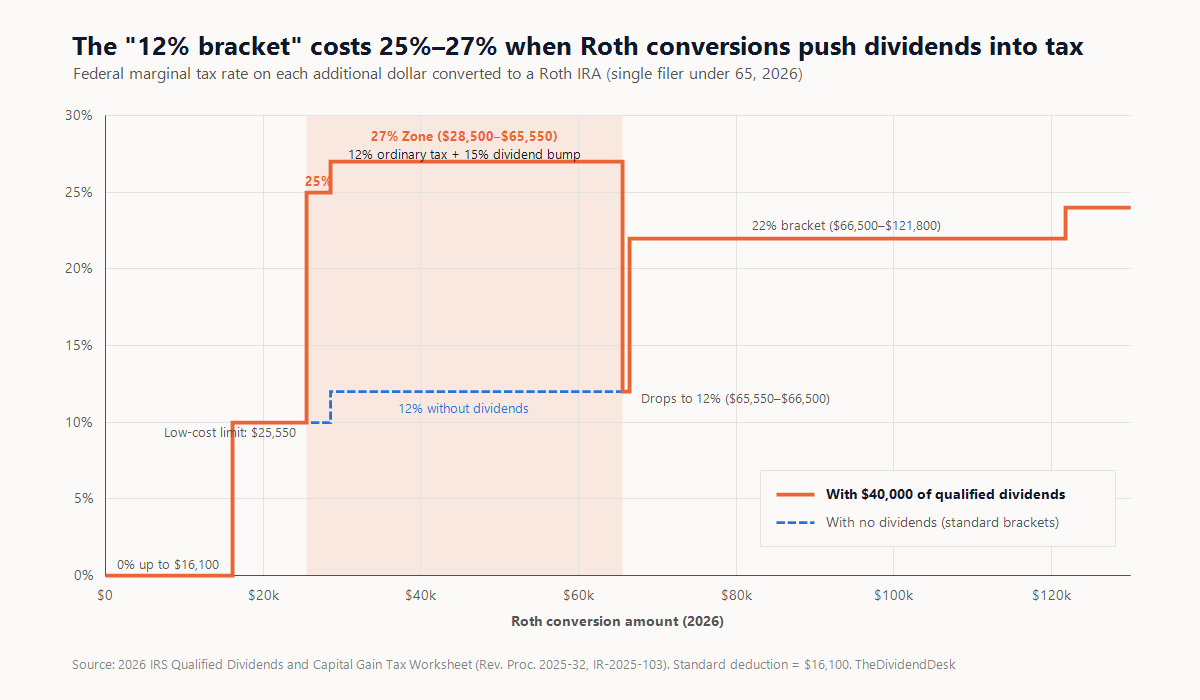
| Conversion Amount | Rate With $40,000 of Dividends | Rate With No Dividends |
|---|---|---|
| $0 – $16,100 | 0% | 0% |
| $16,100 – $25,550 | 10% | 10% |
| $25,550 – $28,500 | 25% (10% + 15%) | 10% |
| $28,500 – $65,550 | 27% (12% + 15%) | 12% |
| $65,550 – $66,500 | 12% | 12% |
| $66,500 – $121,800 | 22% | 22% |
The first $16,100 converts at 0%. Then comes a short 10% stretch. Then, for the next $40,000 of conversions, mostly inside what's normally called the 12% bracket, the rate jumps to 25% and then 27%. When the dividends have all been pushed into the 15% rate, it falls back to 12% for a sliver, then rises to 22%.
The rate isn't a staircase that only goes up. It goes up to 27%, drops to 12%, then settles at 22%.
Three Rules That Fall Out of the Math
Across dividend levels from $10,000 to $60,000 (single) and $20,000 to $120,000 (married), three patterns held. They apply to filers under 65 whose only other income is the dividends, with dividends no larger than $65,550 (single) or $131,100 (married), the most that can be received free of federal tax:
1. The 25–27% zone always ends at the same place. This is the stretch where each converted dollar also pushes a dividend dollar into the 15% rate. For a single filer it ends at a conversion of $65,550, the standard deduction plus the 0% ceiling, however much you receive in dividends. For a married couple it ends at $131,100.
2. It starts at that point minus your dividends, so it's as wide as your dividends. With $40,000 of dividends it runs from $25,550 to $65,550. With $20,000 of dividends it runs from $45,550 to $65,550. (Above $49,450 of dividends for a single filer, or $98,900 for a married couple, the zone starts with a short stretch taxed at 15%.)
3. Filling the 12% bracket costs an extra 15% of your dividends. With $40,000 of dividends, converting $66,500 costs $11,800 in federal tax, versus $5,800 with no dividends. The $6,000 difference is 15% of $40,000: the tax on dividends that would otherwise have been tax-free. The only exception we found was at the highest incomes, where the 3.8% net investment income tax adds a little.
What It Costs at Every Dividend Level
Single filer, under 65:
| Qualified Dividends | Converts at 0% | Low-Cost Limit* | Tax at Low-Cost Limit | Tax to Fill the 12% Bracket ($66,500) | Average Rate | Extra Tax Caused by Dividends |
|---|---|---|---|---|---|---|
| $0 | $16,100 | — | — | $5,800 | 8.7% | $0 |
| $10,000 | $16,100 | $55,550 | $4,486 | $7,300 | 11.0% | $1,500 |
| $20,000 | $16,100 | $45,550 | $3,286 | $8,800 | 13.2% | $3,000 |
| $30,000 | $16,100 | $35,550 | $2,086 | $10,300 | 15.5% | $4,500 |
| $40,000 | $16,100 | $25,550 | $945 | $11,800 | 17.7% | $6,000 |
| $50,000 | $15,550 | $15,550 | $0 | $13,300 | 20.0% | $7,500 |
| $60,000 | $5,550 | $5,550 | $0 | $14,800 | 22.3% | $9,000 |
*The largest conversion before the marginal rate reaches 15% or more. Above it, every dollar costs 15% to 27% until the conversion reaches $65,550.
Married filing jointly, both under 65:
| Qualified Dividends | Converts at 0% | Low-Cost Limit* | Tax at Low-Cost Limit | Tax to Fill the 12% Bracket ($133,000) | Average Rate | Extra Tax Caused by Dividends |
|---|---|---|---|---|---|---|
| $0 | $32,200 | — | — | $11,600 | 8.7% | $0 |
| $20,000 | $32,200 | $111,100 | $8,972 | $14,600 | 11.0% | $3,000 |
| $40,000 | $32,200 | $91,100 | $6,572 | $17,600 | 13.2% | $6,000 |
| $60,000 | $32,200 | $71,100 | $4,172 | $20,600 | 15.5% | $9,000 |
| $80,000 | $32,200 | $51,100 | $1,890 | $23,600 | 17.7% | $12,000 |
| $100,000 | $31,100 | $31,100 | $0 | $26,600 | 20.0% | $15,000 |
| $120,000 | $11,100 | $11,100 | $0 | $29,714 | 22.3% | $18,114 |
*Above it, every dollar costs 15% to 27% until the conversion reaches $131,100. In the $120,000 row, income passes $250,000 near the end, so the 3.8% net investment income tax adds $114 and raises the rate on the last $1,100 of the zone to 30.8%.
At $60,000 of dividends (single) or $120,000 (married), filling the "12% bracket" costs an average of 22.3%, more than the rate of the 22% bracket itself.
Roth Conversion & Dividend Bump Calculator (2026)
See where your low-cost conversion window stops and how much extra dividend tax a Roth conversion triggers.
The Free Part: Your Standard Deduction May Be Doing Nothing
Look at the "Converts at 0%" column. For a single retiree with dividends of up to $49,450, the first $16,100 of conversions costs nothing.
That's because the standard deduction is sheltering dividends that would have been taxed at 0% anyway. It's being wasted. A conversion of $16,100 uses it up, and the dividends that lose its shelter are still taxed at 0%.
For the $40,000 retiree, the low-cost limit is $25,550: $16,100 at 0% and $9,450 at 10%, for $945 in total, an average of 3.7%. Repeated every year from 60 through 64, in 2026 dollars, that would move $127,750 into a Roth for $4,725 in federal tax, assuming no marketplace premium tax credit is at stake.
Where to Stop: "Fill the 12% Bracket" Stops in the Wrong Place
Whether a conversion makes sense depends on comparing the tax now with the tax that money would face later, when it comes out of the traditional IRA. For our $40,000 retiree, here are three possible annual plans:
| Plan | Converted | Federal Tax | Average Rate | Rate on the Dollars Beyond $25,550 |
|---|---|---|---|---|
| Stop at the low-cost limit | $25,550 | $945 | 3.7% | — |
| Fill the 12% bracket | $66,500 | $11,800 | 17.7% | 26.5% |
| Fill the 22% bracket | $121,800 | $23,966 | 19.7% | 23.9% |
The last column is the one that matters for deciding. Converting past the low-cost limit only pays if the extra dollars would otherwise be taxed at more than that rate later.
The surprise is the middle row. Filling the 12% bracket means paying 25% to 27% on most of the extra dollars, then stopping exactly where the rate drops back to 22%. If you're willing to pay for that stretch, the next $55,300 of conversions cost only 22% each. The usual stopping point sits right after the most expensive dollars and right before cheaper ones.
In fact, of these three plans, filling the 12% bracket is never the cheapest, whatever tax rate you expect later. Below about 24%, stopping at the low-cost limit wins. Above about 24%, going into the 22% bracket wins. We found the same at every positive dividend level we tested for single filers, and for couples with up to $100,000 of dividends. The one exception was a couple with $120,000 of dividends, where the net investment income tax makes the 22% bracket more expensive.
Read as a decision rule for this retiree:
- If you expect the money would otherwise be taxed at less than about 24% later: stop at the low-cost limit. (Below 10%, stop at the free $16,100.)
- If you expect more than about 24%: convert through the zone and at least to the top of the 22% bracket ($121,800). Stopping early is the risk: the extra dollars only pay off once you've converted about $118,000 at a 24% future rate, or about $87,000 at 25%.
For a married couple with $80,000 of dividends, the pattern is the same, with one twist. Their low-cost limit is $51,100 (average 3.7%), and filling the 12% bracket costs 26.5% on the extra dollars. But converting deep into the 22% bracket pushes their income over $250,000, where the 3.8% net investment income tax starts to apply to their dividends. That raises the rate on the dollars beyond $51,100 to 25.4% if they fill the 22% bracket.
Two cautions about "the rate later." First, the same stacking applies to future withdrawals: if required minimum distributions would also push your dividends out of the 0% rate, those future dollars carry the same 15% surcharge. Second, a Roth has advantages a pure rate comparison misses, including no required distributions for the owner and tax-free withdrawals for heirs, and paying the conversion tax from outside money effectively adds to the Roth. Both can justify paying somewhat more now.
These comparisons cover federal income tax only. Health insurance subsidies and Medicare premiums, below, can change the ranking.
Other Costs That Can Outweigh the Tax
Health insurance subsidies, the biggest caveat before 65. If you buy coverage through the ACA marketplace with a premium tax credit, that credit depends on your modified adjusted gross income, and conversions raise it. For 2026, the enhanced subsidies of 2021–2025 have expired, so the credit stops entirely once household income passes 400% of the federal poverty line, $62,600 for a single person in the 48 contiguous states. Our $40,000 retiree would lose the whole credit by converting more than $22,600, less than the low-cost limit. Below that line, each converted dollar also trims the credit, by about 16 to 19 cents until income reaches 300% of the poverty line ($46,950), then by about 10 cents. Assuming the benchmark plan costs more than the required contribution, as is typical at 60, the "free" $16,100 conversion would cost this retiree roughly $2,100 of credit. Starting in 2026 there's also no cap on repaying advance credits, so a conversion late in the year can mean repaying the entire year's subsidy. The low-cost limits and plans above assume no marketplace credit.
Medicare premiums. Medicare premium surcharges are based on income from two years earlier, so conversions at 63 and 64 can raise premiums at 65 and 66. For 2026 premiums, surcharges start above $109,000 of income (single) or $218,000 (joint). For our retiree, filling the 12% bracket puts income at $106,500, just under that line, while filling the 22% bracket ($161,800) crosses it.
State income tax. Most states tax conversions as ordinary income, though some, such as Illinois, exempt retirement-plan distributions, including conversions. Our analysis of state taxes on dividends found that a retiree whose dividends were federally tax-free could still owe from $0 to over $3,000 in state income tax, more in Maryland once county tax is added.
At 65 and Older, the Map Shifts Again
Our main scenario is under 65. At 65 and older, two more deductions apply:
- An additional standard deduction of $2,050 for a single filer ($1,650 per spouse for couples).
- A new $6,000 senior deduction per person for 2025 through 2028. Each person's $6,000 shrinks by 6 cents for every dollar of modified adjusted gross income above $75,000 (single) or $150,000 (joint), and a conversion counts toward that income. Married people must file jointly to claim it, and each person needs a Social Security number on the return.
For a single 66-year-old with $40,000 of dividends, the free conversion room grows to $24,150. Once the conversion pushes income past $75,000, each converted dollar also shrinks the senior deduction:
- The 27% stretch becomes about 28.6%, and now ends around $71,400 instead of $65,550.
- The 22% bracket becomes about 23.3%, from roughly $72,300 to $124,500.
- The next stretch costs about 25.4%, until the deduction is fully gone at a conversion of $135,000.
For a couple who are both 65 or older, each spouse's deduction shrinks separately, so they lose 12 cents per dollar of income above $150,000, and the deduction is gone at $250,000. For a couple with $80,000 of dividends, that turns the 27% stretch into about 30.2%, and the first part of the 22% bracket, up to a $170,000 conversion, into about 24.6%. Above that, the deduction is gone and the net investment income tax begins, making it 25.8%.
Social Security benefits add further layers at these ages. We didn't model those here.
Other Details That Change the Map
Net investment income tax. The 3.8% tax applies to dividends once modified adjusted gross income exceeds $200,000 (single) or $250,000 (joint). Those thresholds aren't adjusted for inflation. For a single filer with $40,000 of dividends, it starts with conversions above $160,000.
Paying the conversion tax. Selling shares in a taxable account to pay the tax can realize long-term capital gains. Those stack on top of ordinary income exactly like qualified dividends and can enlarge the zone.
Which income. Qualified dividends and long-term capital gains, including capital gain distributions from funds, create this effect. Distributions from REITs, taxable bond funds, and many covered-call funds are mostly ordinary income. They don't get pushed into a higher rate; they simply use up bracket space.
The five-year rules. If you're under 59½, converted amounts withdrawn within five years, counted from January 1 of the conversion year, can face a 10% penalty. Separately, investment earnings in a Roth come out tax-free only once you're 59½ and your first Roth has been open for five years.
What This Analysis Doesn't Capture
Federal income tax only, 2026 law. Most brackets and thresholds are adjusted for inflation each year. The net investment income tax thresholds and the senior deduction's amounts aren't, and the senior deduction is scheduled to expire after 2028.
One kind of income. We assumed the only other income is qualified dividends. Wages, pensions, interest, Social Security, and capital gains all change the map.
One year at a time. We calculated each year's tax, not a lifetime plan. Choosing the best conversion amount depends on your future tax rates, investment returns, health coverage, and estate plans, which no single-year table can settle.
Credits and other deductions. We assumed the standard deduction and no tax credits.
The Bottom Line
For a retiree living on qualified dividends, a Roth conversion isn't taxed only at its bracket rate. Each converted dollar can push a dollar of dividends from 0% to 15%. In 2026, for a single filer under 65 with $40,000 of dividends, that creates a 25–27% zone mostly inside what's called the 12% bracket. Filling the bracket costs $11,800 in federal tax instead of $5,800, and the extra $6,000 is 15% of the dividends.
The cheapest conversions are the first ones. Up to the standard deduction they can be free, because that deduction was sheltering income already taxed at 0%. Beyond the low-cost limit, the common advice to "fill the 12% bracket" stops right after the most expensive dollars. Before converting, find where your own zone starts. Then either stop before it, or go far enough past it that the average cost makes sense. And if you're under 65 with a marketplace health plan, check the subsidy line first; it can matter more than any bracket.
Sources:
- Brackets and standard deduction: IRS IR-2025-103, "IRS releases tax inflation adjustments for tax year 2026, including amendments from the One, Big, Beautiful Bill."
- Qualified dividend thresholds: Revenue Procedure 2025-32 (0% to $49,450 / $98,900; 15% to $545,500 / $613,700).
- Tax calculation method: IRS Form 1040 instructions, Qualified Dividends and Capital Gain Tax Worksheet.
- Net investment income tax: Internal Revenue Code §1411.
- Additional standard deduction and senior deduction: Tax Foundation, 2026 Tax Brackets.
- Premium tax credit: IRS IR-2025-127 (repayment limits removed after 2025); Revenue Procedure 2025-25 (2026 applicable percentage table).
- Poverty line: HHS 2025 poverty guidelines for the 48 contiguous states ($15,650 for one person; 400% = $62,600).
- Medicare premium surcharges: CMS, "2026 Medicare Parts A & B Premiums and Deductibles" (Nov. 14, 2025).
- Data: roth-conversion-dividend-bump-2026.csv and the rate on every converted dollar.