The 0% Dividend Tax Bracket Stops at the State Line
The 0% Dividend Tax Bracket Stops at the State Line
In our analysis of the 0% dividend tax bracket, we showed how a retiree living on qualified dividends can owe nothing in federal income tax. For 2026, a single filer can collect $65,550 of qualified dividends and stay at $0: the $16,100 standard deduction plus $49,450, the top of the 0% rate for qualified dividends. For a married couple filing jointly, the figure is $131,100 ($32,200 plus $98,900).
That's the federal bill. Most states don't have a 0% bracket for dividends, and most don't tax them at a lower rate. So we asked what the same retiree owes the state.
We calculated it for the 25 most populous states, using each state's own 2026 rules. At the state level, the answer ranges from $0 to $3,100 for a single filer, more in Maryland once county tax is added. And the ranking doesn't match the usual reputation of "high-tax" and "low-tax" states.
The Scenario
| Single | Married Filing Jointly | |
|---|---|---|
| Qualified dividends (only income) | $65,550 | $131,100 |
| Federal adjusted gross income | $65,550 | $131,100 |
| Federal standard deduction | $16,100 | $32,200 |
| Federal taxable income | $49,450 | $98,900 |
| Federal income tax | $0 | $0 |
The filer is a full-year resident, age 55, with no dependents, taking the state's standard deduction. Age 55 is deliberate: several states give retirement-income breaks starting at 62 or 65, and we wanted to measure the base tax before those apply. We cover the age question below.
We computed state income tax only. Local income taxes are excluded, except where we note them for Maryland and Indiana, where every county levies one.
How We Calculated It
We first calculated every state from a national summary table of 2026 state tax parameters. Then we recalculated each state from its own sources, including 2026 rate schedules, withholding guides that state the annual figures, revenue department notices, and enacted legislation, and compared the two.
The two agreed in 14 of the 21 states that tax this income. In the other seven, we traced every difference:
- Missing rules. Some came from rules the summary table didn't capture, such as New York's "recapture" for joint filers and Ohio's base tax amount.
- Out-of-date amounts. Others came from deduction amounts that were out of date, as in California and Maryland.
- Law changed during 2026. Georgia, South Carolina, and Arizona changed their law after the summary table was compiled.
In every case, the figures here use the state's own 2026 rules. Where a state hadn't yet published a final 2026 figure, we used its official provisional or prior-year figure and say so in the table. You can download the full results.
The Results
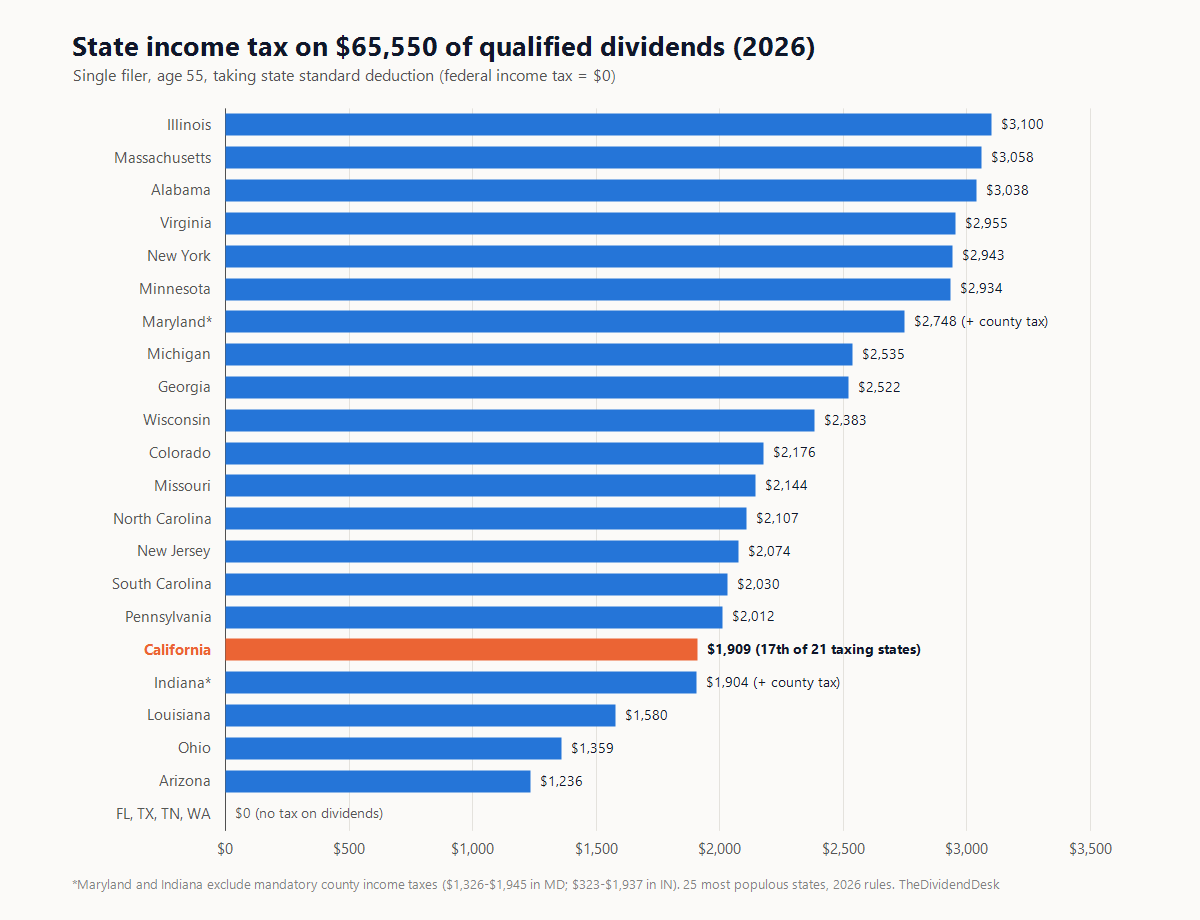
| State | Single ($65,550) | Share of Income | Married ($131,100) | Notes |
|---|---|---|---|---|
| Illinois | $3,100 | 4.73% | $6,200 | |
| Massachusetts | $3,058 | 4.67% | $6,115 | |
| Alabama | $3,038 | 4.63% | $6,075 | 2025 forms; amounts fixed in law |
| Virginia | $2,955 | 4.51% | $5,910–$6,168 | Married figure depends on how dividends are split between spouses |
| New York | $2,943 | 4.49% | $6,036 | Married figure includes recapture |
| Minnesota | $2,934 | 4.48% | $6,128 | |
| Maryland | $2,748 | 4.19% | $5,548 | Plus county tax; standard deduction provisional |
| Michigan | $2,535 | 3.87% | $5,070 | |
| Georgia | $2,522 | 3.85% | $5,045 | 2026 law: 4.99% rate |
| Wisconsin | $2,383 | 3.64% | $5,770 | |
| Colorado | $2,176 | 3.32% | $4,352 | |
| Missouri | $2,144 | 3.27% | $4,468 | |
| North Carolina | $2,107 | 3.21% | $4,213 | |
| New Jersey | $2,074 | 3.16% | $4,358 | |
| South Carolina | $2,030 | 3.10% | $5,027 | 2026 law: new rate structure |
| Pennsylvania | $2,012 | 3.07% | $4,025 | |
| California | $1,909 | 2.91% | $3,818 | 2026 indexed amounts provisional |
| Indiana | $1,904 | 2.90% | $3,808 | Plus county tax |
| Louisiana | $1,580 | 2.41% | $3,161 | Standard deduction provisional |
| Ohio | $1,359 | 2.07% | $3,116 | |
| Arizona | $1,236 | 1.89% | $2,473 | 2026 standard deduction estimated |
| Florida | $0 | 0% | $0 | No income tax |
| Texas | $0 | 0% | $0 | No income tax |
| Tennessee | $0 | 0% | $0 | Hall tax on dividends repealed in 2021 |
| Washington | $0 | 0% | $0 | Capital gains tax doesn't apply to dividends |
Among the 21 states that tax this income, the median bill was $2,176 for a single filer and $5,027 for a couple. The federal bill in every case was $0.
Compare Your State Bill at the Federal 0% Ceiling
Select filing status and two states to compare the 2026 state income tax on $65,550 of qualified dividends (age 55, federal tax = $0).
California Isn't Where You'd Expect
California has the highest top income tax rate in the country. At this income, it ranked 17th of 21. A single retiree there owes $1,909, less than in Pennsylvania ($2,012), New Jersey ($2,074), or Illinois ($3,100).
The reason is the shape of the tax, not the top rate. California's brackets are steeply progressive: its high rates apply to income far above $65,550, and its first several brackets are low. States at the top of our list work differently:
- Illinois taxes nearly everything at a flat 4.95%, after an exemption of $2,925.
- Massachusetts taxes nearly everything at a flat 5%, after an exemption of $4,400.
- Alabama reaches its 5% top rate at just $3,000 of taxable income, and its standard deduction shrinks to $2,500 at this income.
A flat tax with small deductions reaches a retiree's first dollars of dividends. A progressive tax with low bottom brackets mostly doesn't. For a dividend retiree at this income, a state's top rate says little about the bill. The rate on the first $60,000 or so says much more.
County Tax Moves Maryland to the Top
The state-only figure understates Maryland. Every Maryland county levies its own income tax, at rates from 2.25% to 3.30% for 2026. On this retiree's Maryland taxable income, that adds $1,326 to $1,945. The total comes to roughly $4,070 to $4,690, or 6.2% to 7.2% of the dividends. That's more than any other state's state-plus-county total in our sample.
Indiana's counties also levy income tax. At county rates of about 0.5% to 3.0%, it would add roughly $323 to $1,937.
Some cities levy their own income tax as well, and we didn't model those. New York City's tax, for example, would push a New York City resident's total above Maryland's. Check your own locality.
Some States Charge Couples More Than Two Singles
At the federal level, this married couple pays exactly what two single retirees with $65,550 each would pay: $0. In most states, the joint bill is also simply double the single bill. But in nine of the 21 states, the couple pays more:
| State | Married Couple ($131,100) | Two Singles ($65,550 each) | Extra Paid by the Couple | Main Reason |
|---|---|---|---|---|
| Wisconsin | $5,770 | $4,766 | $1,004 | Shrinking standard deduction, and joint brackets less than twice as wide |
| South Carolina | $5,027 | $4,060 | $967 | The $30,000 bracket threshold is the same for every filing status |
| Ohio | $3,116 | $2,718 | $398 | The $26,050 threshold is the same for every filing status |
| Minnesota | $6,128 | $5,868 | $260 | Joint brackets less than twice as wide |
| Virginia | $6,168 | $5,910 | Up to $258 | Only if the dividends are reported under one spouse; the Spouse Tax Adjustment can remove it |
| New Jersey | $4,358 | $4,148 | $210 | Joint brackets less than twice as wide |
| Missouri | $4,468 | $4,288 | $180 | Same brackets for every filing status |
| New York | $6,036 | $5,886 | $150 | Recapture applies at the couple's income but not the single filer's |
| Maryland | $5,548 | $5,496 | $52 | Lowest brackets are the same for every filing status |
The Rules Changed While We Were Calculating
Three of these states changed their 2026 tax law during 2026 itself:
- Georgia cut its rate to 4.99% and raised its standard deduction to $15,000 for single filers ($30,000 joint). The national table published at the start of the year would have overstated this retiree's bill by about $257.
- South Carolina rebuilt its income tax under Act 110 of 2026, with new rates and a state deduction that phases out at higher incomes. The start-of-year table would have overstated the single filer's bill by about $746.
- Arizona raised its standard deduction under HB 4168, effective back to 2025.
Tables and calculators published early in the year can be out of date by mid-year. If you're estimating your state tax, check that your source reflects the current year's law.
Age Changes the Answer in Some States
We used age 55 on purpose, because age matters in some states. Several states exclude some retirement income for older residents, and in a few, the exclusion covers dividends.
The clearest case among these states is Georgia. Its retirement income exclusion is $35,000 per person at ages 62 to 64 and $65,000 per person at 65 and older, and it covers dividends, interest, and capital gains. A single Georgia retiree with $65,550 of dividends would owe about $776 at age 62 to 64 and $0 at 65 or older, instead of the $2,522 shown here.
New Jersey residents 62 and older with little or no earned income may be able to apply the state's unused retirement income exclusion to other income, including dividends, which could remove much or all of the New Jersey bill.
Other states' exclusions are often limited to pensions and retirement-plan withdrawals, so they don't help a retiree living on dividends from a taxable account. Michigan's interest and dividend subtraction, for example, applies only to people born before 1946. If you're 62 or older, check your state's specific rules before using the figures above.
What This Means for Dividend Investors
"Federal 0%" isn't "0%." A retiree who builds a portfolio around the federal 0% bracket can still pay up to 4.7% of that income in state tax alone, and 6% to 7% in Maryland once county tax is added. That's worth building into any income plan.
The difference adds up. At this income, a married couple in Illinois pays $6,200 a year in state tax. In Florida, Texas, Tennessee, or Washington, they pay nothing. That's about $62,000 over ten years under today's rules, before any growth in income. But income tax is only one part of a state's cost. Property taxes, sales taxes, and the cost of living can easily outweigh it, so this table is a starting point, not a moving decision.
Look past the top rate. For income in this range, compare what each state charges on the first $60,000 or so, not its headline top rate.
Account type still matters. Dividends that stay inside an IRA aren't taxed as they're paid. Withdrawals are generally taxed as ordinary income, not as dividends, and some states, including Illinois and Pennsylvania, exempt most retirement-plan withdrawals from their income tax. As our asset location analysis showed, where you hold income-producing funds can matter as much as which funds you hold.
What This Analysis Doesn't Capture
One income level, one age. We modeled the federal 0% ceiling at age 55. At lower incomes or older ages, results and rankings can differ.
Dividends only. We assumed no wages, pensions, Social Security, interest, or capital gains. Mixing income types changes both the federal and state calculation.
Some 2026 figures are provisional. Arizona, California, Louisiana, and Maryland hadn't published final 2026 deduction or bracket amounts when we calculated. Alabama, Ohio, and Pennsylvania hadn't released 2026 forms, though their 2026 parameters are set in law. These typically affect results by a few dollars to a few tens of dollars.
Rate schedules, not tax tables. Some states require filers below certain incomes to look up their tax in tables with small income bands. That can differ from our rate-schedule calculation by a few dollars.
Local taxes. Excluded except for the Maryland and Indiana county ranges noted above.
25 states. These are the 25 most populous states by Census Bureau estimates, chosen before we saw any results. Other states, including several popular with retirees, aren't covered.
Not tax advice. State rules include credits, phase-outs, and residency tests we didn't model.
The Bottom Line
In 2026, a single retiree can collect $65,550 of qualified dividends and owe nothing to the IRS. In the 25 most populous states, the state income tax on that income ranges from $0 in Florida, Texas, Tennessee, and Washington to $3,100 in Illinois. Maryland's total reaches roughly $4,070 to $4,690 once county tax is added. California, known for its high top rate, ranked 17th of 21 taxing states, because its tax is light on the first $60,000.
Couples in nine of those states pay more than two single filers with the same total income, by as much as $1,004 in Wisconsin. And three states changed their rules partway through 2026. The federal 0% bracket is real, but it stops at the state line.
Sources: Each state's 2026 rate schedule, withholding guide, revenue notice, or enacted legislation, including: Illinois Department of Revenue; Massachusetts Circular M (2026); Alabama Department of Revenue; Virginia Code Title 58.1 and Virginia Tax; Minnesota Department of Revenue (tax year 2026 indexing); New York Form IT-2105-I (2026); Comptroller of Maryland 2026 withholding and local rate information; Michigan Department of Treasury (2026 rate determination); Georgia Department of Revenue 2026 Employer's Tax Guide (HB 463); Wisconsin DOR Publication W-234; Colorado DR 0104EP (2026); Missouri DOR 2026 withholding tables; North Carolina G.S. 105-153.7; New Jersey Division of Taxation rate schedules and NJ-1040 instructions; South Carolina DOR Information Letter #26-20 (Act 110); Pennsylvania Department of Revenue; California Franchise Tax Board; Indiana DOR county rates; Louisiana Department of Revenue RIB 26-005; Ohio Revised Code 5747.02; Arizona Legislature HB 4168; Tennessee, Washington, Florida, and Texas revenue authorities for no-tax status. Data: state-tax-on-dividends-2026.csv.